

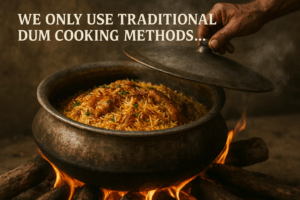
In an era of shortcuts and convenience, few culinary practices have withstood the test of time like dum pukht: the slow, steam-cooking method perfected in the royal kitchens of India. This is not a tradition that we respect at Nawab’s, we live by it. Each serving of biryani has centuries of history, accuracy and attention.
This is more so with our crown jewel; the Hyderabadi Dum Biryani. It is made in only the traditional dum techniques, and it is a dish in which time, patience and authenticity have combined with every bite. This is the reason we never compromise dum cooking and this is the reason why after trying the real stuff, you will never be satisfied with the alternatives.
The Essence of Dum: More Than a Cooking Method
Dum pukht (meaning slow breath) is a kind of cooking technique, in which the food is wrapped in a vessel with a heavy bottom and cooked on a low heat. The steam produced in the interior cooks the food in juices of its own, and preserves flavour, aroma, and tenderness. Dum is not just a process but a philosophy, and it originated in the kitchens of Mughal and thrived in such areas as Awadh and Hyderabad.
This mild approach enables the meat, spices, herbs and rice to merge gradually in their natural richness. It’s not rushed. It’s not faked. It is not something that is accomplished in minutes but rather in hours. It is that very patience that has seen Hyderabadi Dum Biryani being among the most celebrated dishes in the world.
Why Dum is Essential for Hyderabadi Biryani
It is impossible to prepare a real Hyderabadi Biryani with the dum method. In contrast to the other versions of biryanis where meat and rice are prepared separately, Hyderabadi Dum biryani is prepared with the kacchi style, in which uncooked marinated meat is put in a basmati rice and cooked together in a sealed pot. The magic occurs when the flavours are left to mix in low temperature.
The marinated meat will also leave its juices in the rice as the biryani cooks. The aroma and flavors are differentiated due to the use of saffron, caramelized onions, whole-spices, mint, and coriander. The rice is fluffy and aromatic. The meat is unbelievably tender, not dry, not chewy, but soft enough to flake apart under the prick of a fork.
This is only made possible by dum cooking.
At Nawab’s, we do not ignore this process. We cook our own traditionally aged basmati rice, marinate our meats in hours in our blends of hand-made spices, and we seal each pot with dough so that the steam is placed inside. The result? Not only is it a delicious Biryani, but it is a story to be told with each spoonful.
Jaipur foodies prefer online biryani for its unbeatable mix of rich flavors, quick delivery, and restaurant-style freshness at home.
The Flavour That Can’t Be Faked
In the modern kitchens, corners are frequently cut: biryani is cooked under pressure, ready-cooked meats are used or batches are warmed up in microwaves. Such techniques may save time, however, they deprive the biryani of its soul. There can never be a shortcut in the richness that transpires in slow cooking.
At Nawab’s we have chosen to do things the right way, no short cuts at all. Our chefs have been trained in classic techniques of preparing dum, i.e. the way it is in family kitchens and which has been handed over to the generations. All the ingredients are manually made, including piling rice and the exact time of heating. We even have heavy and flame-proof handis (pots) which evenly distribute the heat and retain the steam in the necessary quantity.
When the handi is finally unwrapped on your table or in our kitchen, steam is not the only thing that is lost.
Why We Never Compromise at Nawab’s
Dum cooking to us is not a fad, but a promise of quality, authenticity and experience of the customer.
We have already seen how the dum technique adds to each component of the dish. The meat is laced with fine spices and it is cooked to the point of melting in your mouth. Rice is soaked in the aroma of saffron and stock and is fluffy and intact. The tastes are stratified, rather than mixed. The smell of it is not shallow.
Every element sings and dum is the reason.
That is why we cook our Hyderabadi Dum Biryani in small and well-timed pans every day. It is not on large scale production. It is all about concentration, coordination, and a royal tradition.
While ordering at Nawab’s, you are getting more than a meal. You are experiencing something that celebrates the food culture of Hyderabad.
Dum Cooking: A Heritage Worth Preserving
Slow cooking may be a luxury in the modern hectic society. Still, at Nawab’s, there are things worth waiting for. Dum cooking is not only a matter of technique it is a matter of respect. Reverence towards ingredients, reverence towards history, and above all reverence towards the customer.
We don’t just serve biryani. We offer Hyderabadi Dum Biryani – and there is a difference.
Where others chase trends, we protect tradition. We are more craftsman-like where other people choose convenience. The reason why great biryani is not cooked, but made.
Order from Nawab’s and Taste the Tradition
The best dishes aren’t just cooked, they’re respected. That is the way conventional dum cooking is. It’s not the easiest method. It’s not the fastest. But it is, in any case, the most rewarding.
At Nawab’s, we remain faithful to age-old practice since we think you do not want a meal alone but rather some authenticity.
Sample the richness, spiciness and spirit of the authentic Hyderabadi Dum Biryani, which is made in the Nawab style.
Frequently Asked Questions (FAQs)
Q1: Why is dum cooking so important for Hyderabadi Biryani?
Dum cooking is widely used in the cooking process as it will enable the marinated meat and rice to cook gradually at the same time and leave the two flavors to mix naturally. The end product is soft meat, fragrant rice and a rich, stratified flavor that cannot be achieved using the fast cooking technique.
Q2: What makes Nawab’s Hyderabadi Dum Biryani different from others?
At Nawab’s, we use the kacchi dum method and never use any shortcuts. Our ingredients are of high quality. We marinate our meat in-house, and still cook all our batches freshly in handis. We have prepared our biryani as it was supposed to be prepared, cooked with love, leisure, and respect to the tradition.